


Here’s what no one tells you about the perfect golf swing:
It should be low-effort.
If you want more distance, the secret is to swing faster, not harder. You don’t need to twist and strain. You don’t need to swing out of your shoes. You just need to learn how to generate speed and improve your precision. And you can do both those things effortlessly.
You’re about to learn three key components you’ll find in every perfect golf swing. These components ramp up the power without demanding more effort.
This is a must-know technique for anyone, but you really don’t want to miss out on this if you’re a senior golfer. This is how you get more yards and find more fairways when you lose strength and flexibility.
Let’s get into it.
BONUS: Get Todd Kolb's FREE Effortless Power Cheat Sheet!
The Perfect Golf Swing: Key Takeaways
For more distance and precision, you need:
-
The perfect ball position, which is equal to the buttons on your golf shirt for irons, equal to the logo on your golf shirt for fairway woods, and off the inside of your lead arm for your driver.
-
The longest possible swing, which you can achieve by releasing your trail knee in the backswing and bringing your lead arm straight back and up.
-
Rhythm and tempo, which you can cultivate using the Right Left Drill.
To discover a complete senior-friendly golf system, check out my Vertical Line Swing System.
#1: The Perfect Ball Position
Most golfers don’t think about ball position when they set out to create a more powerful golf swing. But they should.
Finding the correct ball position is crucial for solid, clean contact, and solid, clean contact is crucial for transferring maximum energy into the ball and achieving the ideal ball flight. If you don’t do those things, it doesn’t matter how fast you swing the club.
So let’s get the ball in the right spot.
The Correct Ball Position for Irons
When you’re hitting an iron, you want the ball in the center of your stance, equal to the buttons on your golf shirt.
As a general rule, the low point of your golf swing is in line with your shirt buttons, so placing the ball in this position sets you up to get ball-first contact as the clubhead is traveling at a downward angle.
To find this position:
-
Take your regular setup, but stand with your feet together and the ball between your feet.
-
Step your lead foot toward the target.
-
Step your trail foot an equal distance away from the target.
If the ball is aligned with the buttons on your golf shirt, you’re good to go.

The Correct Ball Position for Fairway Woods
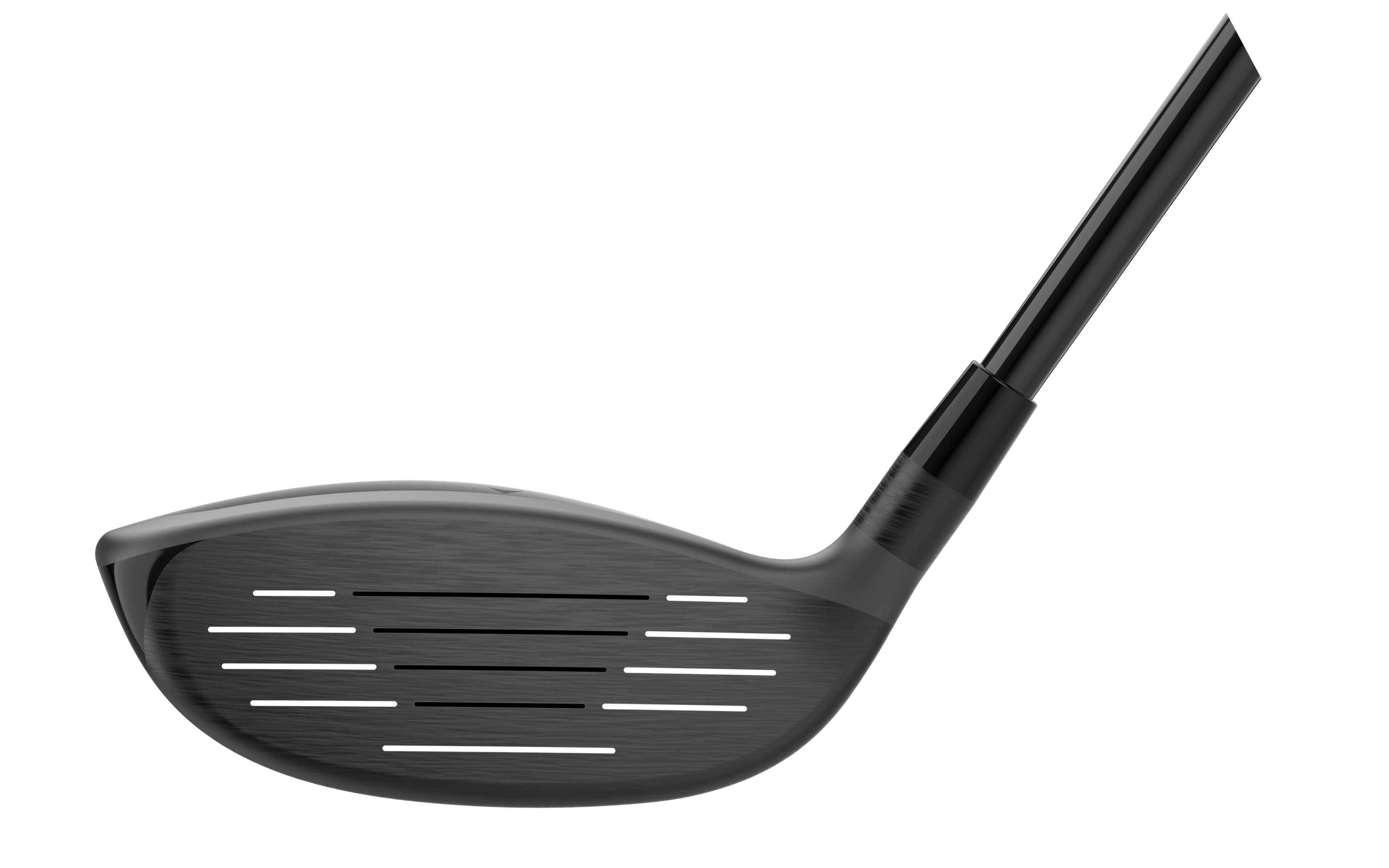
For fairway woods, you want to make contact at more of a sweeping angle. To accomplish this, position the ball off the logo on your golf shirt.
To find this position:
-
Take your regular setup, but stand with your feet together and the ball between your feet.
-
Step your lead foot toward the target.
-
Take a slightly larger step away from the target with your trail foot.
If the ball is equal to the logo on your golf shirt, you’ve got the right spot.

The Correct Ball Position for Your Driver
In your driver setup, the ball should be off the inside of your lead arm. By positioning it so far forward in your stance, you set yourself up to make impact after the low point of your swing, when the clubhead is traveling at an upward angle.
To find this position:
-
Take your regular setup, but stand with your feet together and the ball between your feet.
-
Take a small step toward the target with your lead foot.
-
Take a much larger step away from the target with your trail foot.
Check to make sure the ball is off the inside of your lead arm.

#2: The Longest Possible Swing
A perfect golf swing is a long golf swing. The longer your swing is, the more space you have to build momentum without forcing or straining.
This is where “experienced” golfers run into trouble. If you’ve read my bestselling book The Bad Lie, you know all about how “tried and true” golf tips can actually sabotage a senior golfer’s game.
Traditional golf instruction has taught you to generate speed by restricting the hips and rotating deep. As we get older and lose flexibility, this technique only shortens our swing. It can also be pretty tough on the lower back.
So ditch that strategy. Use these senior-friendly swing strategies instead:
Release the Trail Knee
As you swing the club back, release your trail knee a bit. For example, if you started with a 30° bend in your trial knee, release it to 15° in your backswing.
When you release your trail knee, you have more room to turn your hips (do that) and, as a result, turn your shoulders (do that, too). It creates a chain reaction that allows for more rotation without the pain and strain.

Bring Your Lead Arm Back and Up
Ditch the flat backswing. When your backswing works low and around your body, you can only add length by twisting deeper. Most of us feel our bodies jam up before we get very far.
The better move is to bring the lead arm straight back and up. This vertical golf swing gives you a lot more room, because you’re finding length by raising your arm instead of twisting your body.
Combine this with the hip and shoulder turn you unlock by releasing your trail knee, and you’ve suddenly got the formula for more length and a lot more power.

#3: Rhythm and Tempo
When you see a golf swing that looks effortless but results in jaw-dropping distance, this is what you’re seeing: perfect rhythm and tempo.
Rhythm and tempo define the difference between swinging hard and swinging fast. The Right Left Drill will help you master it.
The Right Left Drill
If you’re left-handed, you’d call this the “Left Right Drill,” but the concept is the same. Here’s how you do it:
-
Take your setup without a golf ball.
-
Make a backswing, saying “right” to yourself as you swing back (or “left” if you’re left-handed).
-
Swing through, saying “left.”
-
Continue this motion, swinging between the top of your backswing and the top of your finish position, saying “right” as you swing right and “left” as you swing left.
You’ll soon find a steady rhythm. Once you feel comfortable in the rhythm, step up to the ball and make your golf swing.

BONUS: Get Todd Kolb's FREE Effortless Power Cheat Sheet!
Go Beyond the Perfect Golf Swing
Incorporate these three components into your golf swing, and you’ll start seeing better golf shots without having to fight your body or strain for more power.
But this is only the beginning.
I’ve developed an entire senior-friendly golf swing system that’s built for ease. This system questions traditional golf advice, not because it’s inherently bad, but because it’s based on the strategies that work for professional players.
And I don’t know about you, but a tour player’s “effortless” is very different from my “effortless.”

My Vertical Line Swing System is designed with your skill set in mind. It capitalizes on your strengths instead of forcing you to fight weaknesses you can’t change. And it gets results. I’ve got golfers in their 80s playing the best game of their lives with this system.
Click here to discover the VLS System for yourself, and get ready to have a lot more fun on the golf course.
About the Author
PGA Teaching Professional Todd Kolb is a five-time Golf Digest Best-in-State Instructor, Amazon Best-selling Author, and Minnesota PGA Teacher of the Year. In over 30 years of coaching, he’s worked with from newbies to an LPGA major champion. He’s currently the Director of Instruction for VLS Golf and USGolfTV and dedicates his efforts to helping the everyday golfer cut through overcomplicated traditional instruction to find solutions that actually work for them.





Share:
The Classic Todd Kolb Chipping Lesson: 3 Tips for Fast Gains
Senior Hybrid Setup: 3 Keys for Better Shots