

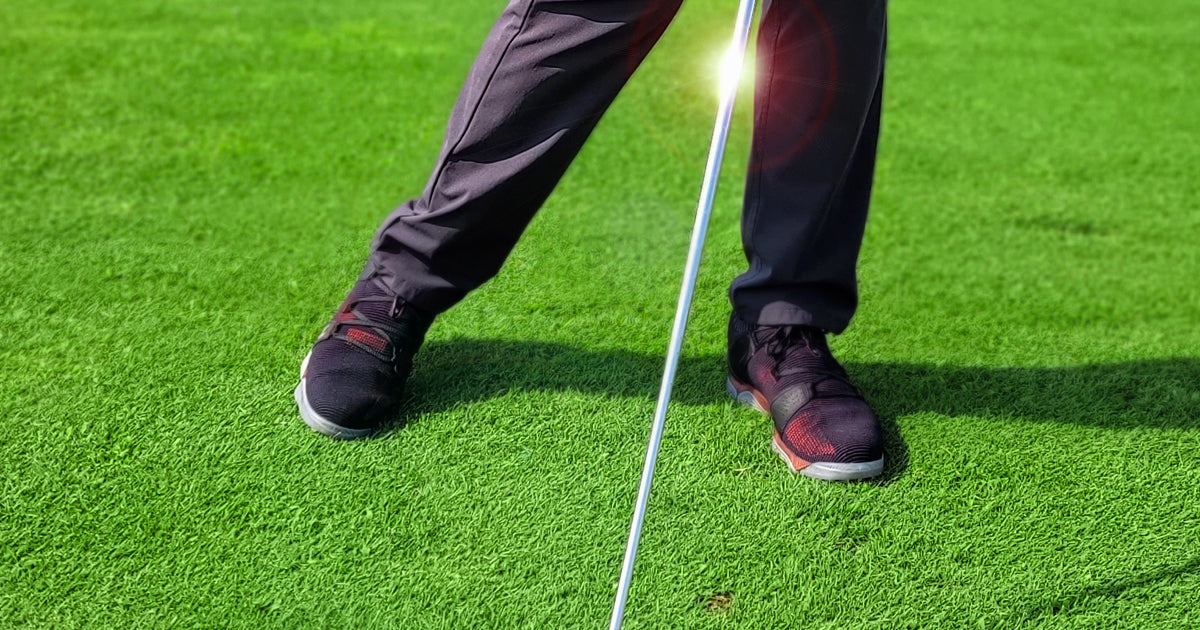
If you want to clean up your contact or maximize your clubhead speed, the first thing you’ve got to do is learn how to shift weight in your golf swing.
It’s such a simple concept, but the correct weight shift makes a universe of difference. This one simple move is the secret to controlling your low point, finding your tempo, and picking up distance without wringing yourself out.
And a lot of golfers get it wrong, either because they never learned how to shift their weight or because—in the case of my “experienced” golfers—they’ve picked up bad habits as they’ve lost stability.
If you’re missing this skill, we’re going to fix that today. We’ll discuss where your weight should be in four different segments of your golf swing, and you’ll learn easy drills for putting these concepts into practice.
Let’s get to it.
Master the Golf Weight Shift: Key Takeaways
Here’s the short version of everything we’re about to cover:
-
Weight shift refers to the shifting of weight between your feet over the course of your golf swing.
-
Senior golfers can find more balance as they shift their weight by setting up with their toes flared.
-
In the setup, you want about 60% of your weight on the lead foot.
-
At the top of your backswing, most of your weight should have shifted to your trail foot. (Use the Step Drill to practice this.)
-
At impact, you want most of your weight on your lead foot. (Use the Step Drill to practice shifting forward.)
-
In your finish position, you should have nearly all your weight on the lead foot.
-
To practice the proper weight shift, learn the Right, Left Drill.
-
If you want to continue improving your contact, check out my Pure Ball-First Contact Series.
Now let’s get into the details, starting with the big question:
What is the Golf Weight Shift and Why Does It Matter?
When we talk about weight shift in your golf swing, we’re talking about the way your weight moves from one foot to another throughout your swing motion.
If you’ve played any other sport—even if you’ve only watched any other sport—you’re familiar with this concept.
In baseball, the pitcher shifts their weight back as their arm comes back, then moves their weight forward with the ball. When tennis players serve the ball, they shift their weight back, then bring it forward with the racket.
The same athletic movement applies in golf.
You want your weight to shift with the clubhead.
To be more specific, your club, body, and arms should all move in the same direction. For the most part. There are some exceptions, but we’re not getting into all that today. Just know that if your weight follows the club, you’ve most likely got it right.
As for why it’s so important, the proper weight shift gives golfers two big wins:
-
It improves contact, because the low point of your swing follows the position of your weight.
-
It maximizes clubhead speed and distance, because it allows you to tap into your most reliable power source: side-to-side motion.
I’ll explain what your weight shift should look like in four major segments of your swing, but first, I want to offer a game-changing tip for my “experienced” golfers.
Weight Shift Tip for Senior Golfers:
As I mentioned before, a lot of experienced golfers struggle to shift their weight properly. If your balance isn’t what it once was, you may be subconsciously avoiding the weight shift.
Now, the secret is to shift your weight to the inside of the foot, not the outside. That’s true for all golfers, but it’s an especially helpful tip for seniors, as it keeps you in control of your balance. It’s when you shift weight to the outside of the foot that you sway.
But I’ve got another suggestion that’s just for seniors. In fact, it’s one my best senior-specific swing tips.
Flare your toes in your setup, pointing your lead toe a little toward the target and your trail foot a little bit away from the target.
You can decide how much flare you want. This will help you rotate better so you get more length in your swing, and it gives you a more solid base so you feel grounded in your weight shift.
Where Should Your Weight Be in the Setup?
Setting up with proper weight distribution is such an essential step that we have a term for it at VLS Golf: the 60/40.
In your setup, you want about 60% of your weight on the lead foot and 40% on the trail foot.
A lot of golfers start with a 50/50; their weight is evenly distributed between their feet. This robs you of that precious momentum you get from loading extra weight into your trail foot as you swing back.
To promote the 60/40, bump your lead hip over your lead foot in your setup. That will force the right amount of weight into the front foot.

Where Should Your Weight Be at the Top of the Backswing?
As you now know, your weight should follow the clubhead. So as you swing back, shift your weight to the trail foot.
And how much weight should be in your trail foot at the top of your backswing?
It depends on the club. The longer the club, the more weight you want in your trail foot at the top of your backswing. For a wedge, aim for around 60% of your weight. For a driver, it’ll be more like 75-80%.
This is where I should remind you to shift your weight to the inside of your trail foot. That’s what we call a pivot.
Do not shift your weight to the outside of your trail foot. That’s a sway. It’ll mess with your balance and ruin your shot.
Here’s a great drill for practicing this weight shift:
Step Drill (Trail Foot)
-
Set up for a practice swing (no ball) with your feet together and the club in the middle of your feet.
-
As you swing back, step your trail foot away from the target.
-
Complete your practice swing as you normally would.

You can probably see how this drill trains your body to shift weight into the trail foot on the backswing. But it also forces you to get into the habit of putting your weight on the inside of your trail foot. You wouldn’t put it on the outside of your foot when you stepped down; you’d roll your ankle.
Run this drill a few times when you practice your swing, and you’ll start naturally shifting your weight without fearing the sway.
Where Should Your Weight Be at Impact?
You’ve probably got this one figured out, but I’ll say it anyway:
Most of your weight should be on your lead foot at impact.
Once again, your club will determine how much weight you should move forward, but if we’re talking about a 6-iron or a 7-iron, you’d want about 70-85% of your weight on the lead foot. You’re shifting your weight toward the target at this point, and you want to give it a lot of power.
It’s also important to note that, at this point in your swing, your club will hit the ground wherever your weight is.
That’s why proper weight shift is so crucial for your contact. If you tend to keep your weight on the trail foot through impact (a common mistake among senior golfers), you probably top the ball a lot. By keeping your weight back, you also bring the low point of your swing farther back in your stance.
On the other hand, if you have the majority of your weight on your lead foot at impact, you’re going to make ball-first contact.
Here’s how to practice this one:
Step Drill (Lead Foot)
-
Set up for a practice swing (no ball) with your feet together and the club in the middle of your feet.
-
Swing back, keeping your feet together.
-
As you swing down, step your lead foot toward the target.

Feels pretty familiar, right? It’s the same as the last drill; you’re just moving your lead foot instead of your trail foot.
This is the drill you want to practice if you’re one of those guys or gals who instinctively stays on the trail foot through impact. This exercise will teach your body how it feels to move the weight forward through the strike, and you’ll learn how to make that transition in a way that maintains your stability.
Where Should Your Weight Be at the Finish?
By the time you’re in your finish position, your weight should be almost entirely in the lead foot. We’re talking 90-95%. That’s the goal for every full-swing shot, no matter which golf club you’re swinging.
Now, there are a couple checkpoints to make sure you’ve got your weight where you want it.
One, your knees should be touching (or almost touching, if your body doesn’t work that way).
Two, your trail heel should be off the ground so you’re up on the toe. If you trust your balance, you can even test your weight distribution by seeing if you can give the trail toe a little tap. If it’s easy, you’ve got your weight in the right spot.
To get into this position, take your swing with the goal of getting your knees to touch at the finish. Your weight naturally has to move forward in order to do that. It’s a great way to find that perfect weight shift without even trying.
To make things even easier, I’ve got a great drill you can use in your pre-shot routine to help your body find the feel for the right motion.

The Best Drill for Practicing Weight Shift in Your Golf Swing
This is one of the best drills in my toolbox. We use it at VLS Golf to build all kinds of skills, but it’s especially useful for perfecting the pivot.
Right, Left Drill
-
Take your regular setup without a golf ball.
-
Make continuous practice swings, saying “right” as you swing the club back and “left” as you swing down and through. (Left-handed golfers will do the opposite.)
-
Continue this motion without pauses between swings, then step up to the golf ball and say “right, left” again as you make your golf shot.
To be clear, you don’t have to say “right, left” out loud. It works just as well to say it in your head. The idea is to communicate to your body that it should be working in harmony with the club, moving in the same direction.
You also don’t want to make full-speed swings. What matters is the continuous motion. As you keep swinging back and forward without pausing, your arms, body, and club will naturally sync up.
When you step up to hit the golf ball, that synchronicity will stay with you.
And you’ll have perfected your weight shift.
The Next Step for Mastering Contact
Getting the weight shift right is a major first step toward improving your contact. Practice the concepts you just learned, and you’re guaranteed to start hitting more controlled shots.
But if you want to be that golfer who seems to always hit it pure without breaking a sweat, you need to get a few more pieces in place.
Fortunately, the rest of the formula is pretty simple, and you can learn it all in my Pure Ball-First Contact Series.
In five short video chapters, we ignore all the complicated tips that have only made the game harder and drill down to the one key objective that determines your ability to make ball-first contact.
You’ll get crystal-clear instruction that’s easy to execute, plus a lot of drills to turn those concepts into muscle memory. We’re all about keeping the golf swing simple at VLS Golf, because the clearer your head is, the better you play.
Click this link to start the Pure Ball-First Contact Series today.
About the Author
PGA Teaching Professional Todd Kolb is a five-time Golf Digest Best-in-State Instructor, Amazon Best-selling Author, and Minnesota PGA Teacher of the Year. In over 30 years of coaching, he’s worked with from newbies to an LPGA major champion. He’s currently the Director of Instruction for VLS Golf and USGolfTV and dedicates his efforts to helping the everyday golfer cut through overcomplicated traditional instruction to find solutions that actually work for them.







Share:
This Simple Putting Stroke Is the Secret to Lower Scores
5-Second Setup Routine to Fix Your Fairway Wood Swing